Last Updated: July 24, 2026
|Publish Date: July 6, 2026
Learn how auditors reconcile WACC, WARA, and IRR in every ASC 805 purchase price allocation. Discover why reconciliations fail, acceptable tolerance ranges, common audit red flags, and how to build an audit-ready PPA valuation.
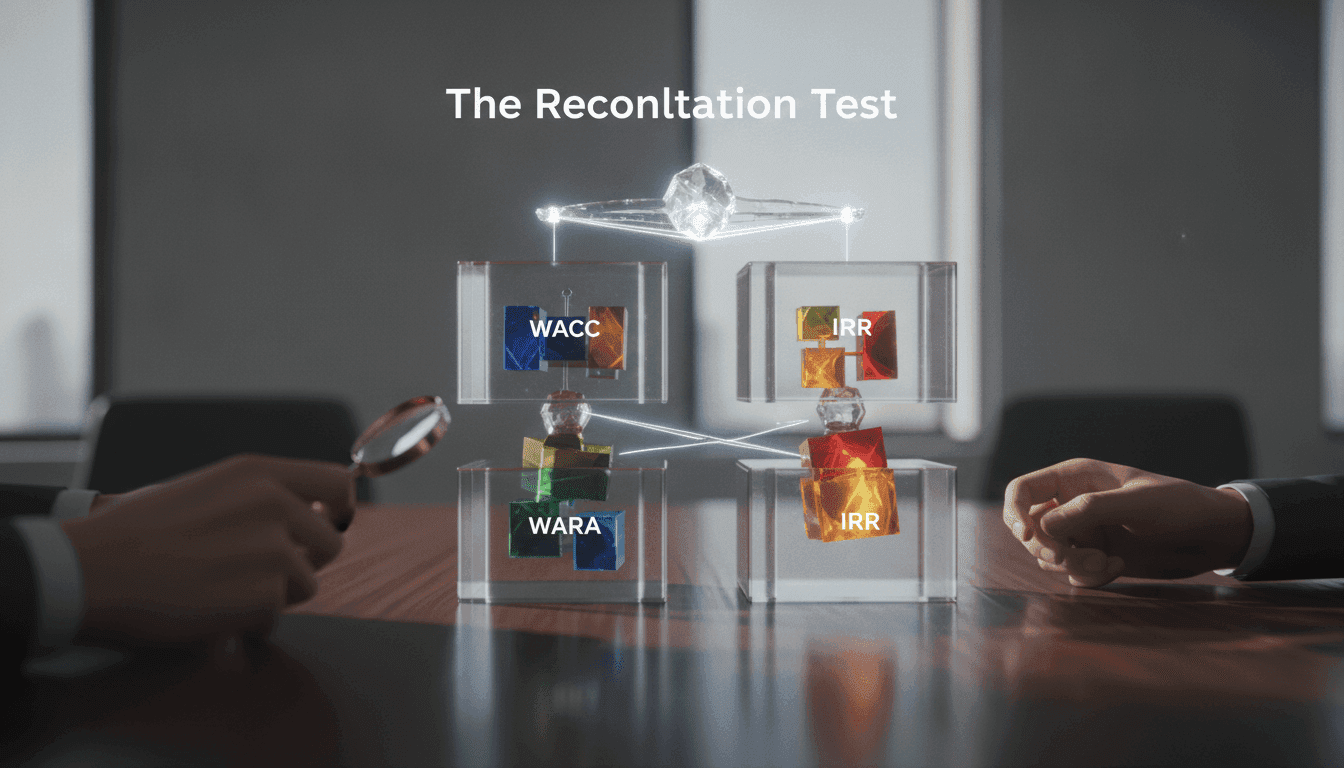
If you're preparing an ASC 805 purchase price allocation (PPA), expect one of the first questions from your auditor to be: "Do WACC, WARA, and the deal IRR reconcile?" Before reviewing the valuation of customer relationships, technology, trade names, or goodwill, auditors typically perform this high-level reasonableness check to determine whether the economics of the transaction make sense as a whole. If these three metrics don't tell a consistent story, expect follow-up questions, additional support requests, and sometimes revisions to your purchase price allocation before the audit can move forward. The good news is that auditors are not looking for identical numbers. They're looking for a logical relationship supported by market participant assumptions, consistent valuation methods, and clear documentation that explains why the differences exist.
What Your Auditor Is Really Checking
Before auditors dive into your detailed valuation models, they typically perform a high-level reconciliation using three key metrics: WACC, WARA, and the deal IRR. Think of this as the first audit checkpoint. Auditors aren't expecting these numbers to match exactly, but they do expect them to tell the same economic story. As a practical rule of thumb, a WARA that falls within roughly 0.5%–2.0% of WACC is often easier to support, although there is no prescribed accounting threshold. Larger gaps aren't automatically incorrect, but they must be backed by clear explanations. If the reconciliation doesn't make sense, auditors will usually dig deeper into your discount rates, contributory asset charges (CACs), cash flow forecasts, asset allocation methodology, and goodwill calculation. A well-supported reconciliation helps establish confidence in your purchase price allocation from the outset, while unexplained differences almost always lead to additional questions, more supporting documentation, and potentially longer audit timelines.
Key Takeaways
Audit reality: External auditors routinely compare the weighted average cost of capital (WACC), weighted average return on assets (WARA), and the buyer’s internal rate of return (IRR) as a reconciliation test on every material ASC 805 purchase price allocation.
WACC vs WARA linkage: WARA must conceptually reconcile back to WACC after considering capital structure, contributory asset charges, and the risk profile of specific intangible assets—large gaps signal modeling or assumption errors.
Deal IRR as a reasonableness check: If the transaction IRR implied by the purchase price is materially misaligned with WACC and WARA, auditors will question whether the PPA valuation reflects realistic market participant economics.
Intangible asset risk differentiation: Customer relationships, technology, trade names, and assembled workforce rarely share the same required return; forcing a single discount rate across assets is a red flag in audit reviews.
Defensible framework, not a single “right” number: The objective is not mechanical equality among WACC, WARA, and IRR, but a coherent, documented valuation narrative that can withstand PCAOB-level scrutiny.
What Are WACC, WARA, and IRR in the Context of ASC 805 Purchase Price Allocation?
In an ASC 805 PPA valuation, WACC represents the required return to all capital providers, WARA reflects the weighted average required return on the individual acquired assets, and IRR represents the buyer’s expected return on the transaction based on projected cash flows and purchase price. Auditors use these three rates together to test whether your allocation of the purchase price across tangible and intangible assets is economically consistent with market participant assumptions.
How Is WACC Typically Determined for a PPA?
WACC in a PPA context is generally derived from a market participant capital structure, cost of equity, and cost of debt, rather than the acquirer’s idiosyncratic financing. It serves as the anchor rate against which asset-level discount rates and the deal IRR are compared.
In practice, your valuation team will estimate WACC using approaches consistent with US valuation and accounting guidance: CAPM-based cost of equity using guideline public companies, observable borrowing costs adjusted for tax effects, and a capital structure aligned with comparable companies or industry norms. Auditors focus heavily on whether WACC aligns with the risk profile of the acquired business, not just the buyer’s own balance sheet.
What Does WARA Represent, and Why Do Auditors Care?
WARA (Weighted Average Return on Assets) represents the blended rate of return required across all acquired assets based on their respective fair values and risk profiles. Auditors compare WARA with WACC because the two should generally support the same overall economics of the transaction.
There is no accounting rule that requires WARA to equal WACC exactly. Instead, auditors expect the difference to be reasonable and supported by the characteristics of the acquired assets.
For example:
WACC = 10.5%
WARA = 10.2%
This would usually be considered reasonable if the supporting assumptions are well documented.
However:
WACC = 10.5%
WARA = 6.8%
would likely prompt additional audit questions because the implied asset-level risk appears inconsistent with the overall cost of capital.
Similarly, a WARA significantly above WACC may indicate that certain assets have been assigned excessive discount rates or that value has been allocated inconsistently across the purchase price allocation.
How Does Deal IRR Fit into the PPA Reconciliation?
Deal IRR (Internal Rate of Return) represents the buyer's expected return on the acquisition based on the purchase price and projected future cash flows. Although ASC 805 does not require a formal IRR reconciliation, experienced auditors frequently compare the deal IRR with WACC and WARA to determine whether the transaction economics appear reasonable.
Consider a simple example:
WACC = 10.5%
WARA = 10.3%
Deal IRR = 17.8%
An auditor will immediately ask where the additional return is coming from. If management expects strategic synergies, platform expansion, or operational improvements, those assumptions should be clearly documented and should not be double-counted in both the acquisition model and the purchase price allocation. The objective isn't to make every percentage identical but to ensure the numbers support one consistent economic story.
How Do Auditors Perform the WACC–WARA–IRR Reconciliation in a PPA Valuation?
Auditors typically start from the WACC, confirm that asset-level discount rates and contributory asset charges are conceptually consistent, and then compute WARA to see whether it reasonably aligns with WACC. They then compare both to the deal IRR derived from management’s transaction model to assess whether the PPA valuation reflects realistic acquisition economics.
The reconciliation process often follows a structured sequence:
Step 1 – Validate WACC: Confirm that the cost of equity, cost of debt, and target capital structure reflect market participant assumptions, are supported by guideline company analysis, and align with the risk profile of the acquired business.
Step 2 – Review asset-level discount rates: Assess whether discount rates for customer relationships, developed technology, in-process R&D, trade names, and other intangibles are logically ordered by risk and are properly derived from WACC with relevant premiums or adjustments.
Step 3 – Compute WARA: Multiply each asset’s required rate of return by its fair value, sum those products, and divide by the total fair value of all assets to determine the portfolio-level WARA.
Step 4 – Compare WARA to WACC: Evaluate the spread and its drivers—asset mix, risk adjustments, contributory asset charges, or economic rents. A modest spread with a clear narrative is generally acceptable; unexplained divergence is not.
Step 5 – Bench IRR against WACC/WARA: Using the deal model, calculate the IRR on invested capital and compare it to WACC and WARA, documenting why any differences are reasonable (for example, strategic synergies, platform value, or expected multiple expansion).
Why Do Auditors Challenge WACC–WARA–IRR Reconciliations?
Most reconciliation issues are not caused by calculation errors—they result from inconsistent assumptions across the transaction model and the purchase price allocation. When WACC, WARA, and deal IRR point to different economic conclusions, auditors will usually ask for additional evidence before accepting the valuation. In our experience, these are the most common reasons why reconciliations fail during audit reviews.
Common drivers include:
Using entity-specific instead of market participant assumptions: Relying on the acquirer’s leverage, tax rate, or risk profile rather than that of a market participant operating the acquired business can distort WACC and deal IRR comparisons.
Flat discount rates across heterogeneous assets: Applying the same rate to customer relationships, technology, and trade names ignores risk differentiation and produces a WARA that may not reconcile with WACC.
Misalignment between transaction model and PPA cash flows: Including synergies in the deal IRR but excluding them from the PPA valuation, or vice versa, will skew the relationship among IRR, WACC, and WARA.
Improper contributory asset charges (CACs): Overstated or understated CACs can materially change the returns attributed to individual intangible assets, shifting WARA away from WACC without a defensible rationale.
Inconsistent tax assumptions: Using different effective or marginal tax rates in the WACC derivation and PPA cash flows can create artificial spreads between WACC, WARA, and IRR.
How Should You Interpret Differences Between WACC, WARA, and IRR?
WACC, WARA, and IRR are not expected to be identical, and experienced auditors know that. What they expect is a logical relationship supported by market participant assumptions and consistent valuation methodology. Small differences are common, but larger gaps should always be supported with a clear explanation.
For example:
Scenario 1
WACC = 10.4%
WARA = 10.7%
IRR = 11.5%
This generally represents a reasonable reconciliation if the transaction includes identifiable strategic benefits.
Scenario 2
WACC = 10.4%
WARA = 15.8%
IRR = 8.1%
This would almost certainly lead to additional audit questions because the three rates are telling very different economic stories.
In practice:
WARA slightly above WACC: May be acceptable if the acquired asset base skews toward higher-risk intangibles and if there is clear support for asset-level risk adjustments.
WARA slightly below WACC: May be defensible when a large portion of value is in lower-risk assets such as working capital, fixed assets, or contractual customer relationships with strong protections.
IRR above WACC/WARA: Often reflects expected synergies, platform value, or strategic optionality; auditors will expect explicit documentation of these drivers and assurance they are not double-counted in the PPA.
IRR below WACC/WARA: Raises questions about whether the buyer accepted sub-economic returns for strategic reasons or whether projections are conservative—both scenarios require a clear narrative and supporting evidence.
How Do WACC, WARA, and IRR Affect Your Balance Sheet and Future Earnings?
The interplay between WACC, WARA, and IRR influences not only audit defensibility but also the allocation of purchase price among tangible assets, identifiable intangibles, and goodwill, which in turn affects future amortization and potential impairment testing. A misaligned framework can result in excessive goodwill, aggressive intangible valuations, or an amortization profile that does not reflect economic reality.
For high-growth technology and SaaS acquirers, this directly impacts:
Post-acquisition EPS and EBITDA: The relative value assigned to finite-lived intangibles versus goodwill determines future amortization expense and reported profitability.
Impairment risk under ASC 350 and ASC 360: Overstated goodwill or intangibles increase the likelihood of future impairment charges if performance lags the acquisition model.
Debt covenant headroom: The pattern of amortization and impairment can influence leverage ratios and interest coverage metrics monitored by lenders and investors.
What Is a Defensible Framework for WACC–WARA–IRR in Your Next PPA Valuation?
A defensible framework integrates transaction modeling, market participant assumptions, and asset-level valuation techniques into a coherent narrative that auditors can trace from the term sheet to the final PPA schedules. The objective is rigorous internal consistency, not mechanical equality of every rate.
Key elements of a robust framework include:
Early alignment between deal and valuation teams: Ensure that the same base-case projections, tax assumptions, and capital structure views underpin both the investment thesis (IRR) and the PPA valuation.
Transparent derivation of WACC: Document guideline public company selection, beta estimation, equity risk premium, size and company-specific risk adjustments, and cost of debt inputs consistent with US valuation practice.
Structured asset-level rate setting: Start from WACC and calibrate asset discount rates using relative risk assessments (contractual vs non-contractual, technology life cycle, customer concentration, legal protections).
Formal WARA and IRR reconciliation memo: Prepare a concise internal paper that walks through WACC, WARA, and IRR, explains spreads, and ties them back to asset mix, synergies, and strategic rationale.
Ongoing calibration with performance: Post-close, compare actual performance to the acquisition model to inform future PPAs and support auditors’ retrospective reasonableness assessments.
Securing Defensible Valuations with AcumenSphere
Regulators, audit firms, and—by extension—your board are applying increasing scrutiny to valuations that affect financial reporting, particularly ASC 805 PPAs where WACC, WARA, and IRR must withstand detailed challenge. For venture-backed and growth-stage companies operating in environments like Silicon Valley, New York, or Austin, a misstep here can delay audited financials and complicate future capital raises or exits.
Based in California’s Bay Area, AcumenSphere’s US-based professionals—CPAs, CFAs, and valuation specialists with ABV® and related credentials—deliver audit-ready, defensible valuation and corporate advisory solutions tailored to US GAAP and IRS frameworks. Our team integrates ASC 805, ASC 820, and related financial reporting requirements with transaction modeling to ensure that your PPA valuation, including the WACC–WARA–IRR reconciliation, aligns with auditor expectations and market participant economics.
To discuss your upcoming valuation requirements or review your cross-border or acquisition-related compliance framework, schedule a consultation with our US advisory team. We will help you structure a defensible, well-documented valuation approach that supports your financial reporting, capital strategy, and long-term transaction objectives.
Need an Audit-Ready Purchase Price Allocation?
A purchase price allocation (PPA) is more than an accounting exercise—it must withstand auditor review, support your financial statements, and accurately reflect the economics of the transaction. If your WACC, WARA, and deal IRR don't reconcile with a clear and well-documented rationale, audit questions, reporting delays, and costly revisions can follow.
At AcumenSphere, our US-based valuation professionals help founders, CFOs, private equity firms, and corporate finance teams prepare audit-ready ASC 805 purchase price allocations backed by defensible assumptions, transparent methodologies, and robust WACC–WARA–IRR reconciliation analyses. Whether you're completing your first acquisition or managing complex cross-border transactions, we deliver valuation reports that stand up to auditor scrutiny and support confident financial reporting.
If you're preparing for an acquisition, finalizing a purchase price allocation, or responding to auditor review comments, our team is here to help.
Speak with our valuation specialists today:
📞 Phone: +1 (510) 203-9584
📧 Email: info@acumensphere.com