Team AcumenSphere
|Last Updated: September 2, 2026
|Publish Date: September 2, 2026
LBO valuation is the method used to price a company by working backward from a private equity sponsor's target return, based on the debt used to fund the deal and the cash flow available to repay it, rather than the company's standalone value.
LBO valuation is the method private equity sponsors use to work out the maximum price they can pay for a company while still hitting a target return, once the deal is funded with debt. Unlike a discounted cash flow model, which asks what a business is worth on its own, an LBO valuation model asks a different question: how much can a sponsor pay today and still deliver the return investors expect after running the business for three to seven years and selling it at exit.
Most analysts get the mechanics of leverage right and still misprice the deal, because the model's structure hides which assumptions are actually driving the return. A leveraged buyout model can look sound on a spreadsheet and still fall apart the moment cash flows are tested against real debt covenants and a less generous exit multiple. This guide walks through how an LBO model is structured, which drivers move returns the most, and where valuations most often go wrong.
Key Takeaways
• Debt drives price, not intrinsic value: in LBO valuation, the purchase price is worked backward from how much debt the target's cash flow can service and the return a sponsor needs, not from standalone worth.
• IRR and MOIC are the scorecard: sponsors typically target a 20% to 25% IRR and a 2.0x to 3.0x MOIC over a three-to-seven-year hold, and the model exists to test whether a price can hit those numbers.
• Leverage cuts both ways: a capital structure of 60% to 70% debt means small shifts in EBITDA growth or exit multiple swing equity returns significantly.
• Exit multiple assumptions carry more weight than entry price: many LBO models are more sensitive to the assumed exit multiple than to the multiple paid at entry.
• A single-scenario model is a guess: returns should be stress-tested across leverage, growth, and exit multiple ranges through an LBO sensitivity analysis before the valuation is trusted.
What Is LBO Valuation?
LBO valuation is the process of determining the maximum price a private equity sponsor can pay for a target company while still achieving its required return once the deal is funded with a mix of debt and equity. Instead of answering what a company is worth, it answers what the company's cash flow can afford to pay off and what is left over for equity holders at exit. This is why LBO analysis and private equity valuation work often produce a different number than a market-based or intrinsic valuation of the same company.
People searching for what is leveraged buyout model or what is an lbo model are usually trying to understand this distinction: an LBO model isn't measuring value in the abstract, it is measuring debt capacity and equity upside for one specific buyer under one specific financing structure. Two sponsors bidding on the same company can arrive at two different maximum prices simply because they assume different leverage levels or return hurdles.
How an LBO Model Is Structured
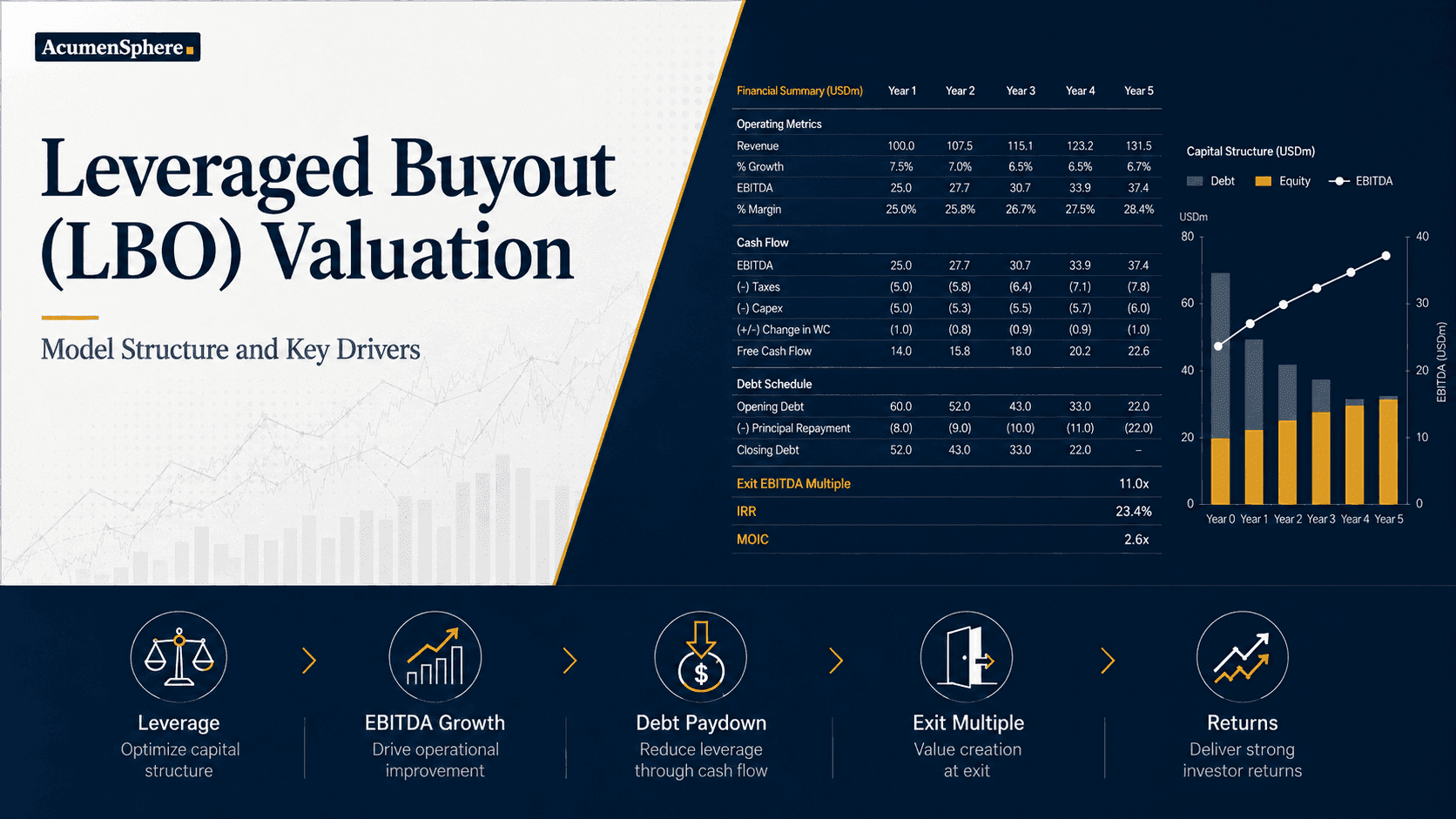
An LBO model's structure is built around five interlocking blocks: sources and uses, the opening capital structure, an operating model that projects revenue and EBITDA, a debt schedule that tracks paydown, and a returns calculation at exit. Building an LBO valuation model step by step means working through each block in that order, since each one feeds the next.
• Sources and uses: lays out the total purchase price plus transaction fees, and how that amount is funded through debt tranches and the sponsor's equity check.
• Capital structure: senior secured debt is typically sized at 3x to 5x EBITDA, sometimes layered with subordinated or mezzanine debt, keeping the overall debt-to-EBITDA ratio within what the target's cash flow can support.
• Operating model: projects revenue, margins, and free cash flow projections across the hold period, since every downstream calculation depends on these assumptions holding up.
• Debt schedule: tracks mandatory amortization, interest expense, and any cash sweep that accelerates paydown, which determines how much debt remains outstanding at exit.
• Returns calculation: exit enterprise value, based on exit EBITDA and an assumed multiple, minus remaining debt, gives the equity value returned to the sponsor, from which IRR and MOIC are calculated.
What Are the Key Drivers of LBO Returns?
Three levers drive LBO returns: EBITDA growth during the hold period, debt paydown funded by free cash flow, and the multiple at which the business is sold at exit. Of the three, disciplined EBITDA growth combined with steady deleveraging is the more reliable path to target returns, while relying on multiple expansion alone is the riskiest assumption in an LBO analysis.
Consider a sponsor buying a company at 8x EBITDA with 65% debt financing. Modest EBITDA growth and standard debt paydown are often enough to see sponsor equity returns compound, because leverage amplifies the equity holder's share of any value created. That same structure cuts the other way too: a shortfall in EBITDA growth or a weaker exit multiple erodes returns faster than it would in an unlevered deal, which is exactly why these key drivers of returns in a leveraged buyout deserve more scrutiny than the entry price itself.
LBO Valuation vs Other Valuation Methods
LBO valuation differs from comparable company analysis, precedent transaction analysis, and DCF-based approaches like the Gordon Growth Model because it isn't trying to establish intrinsic or market value. It is solving for the highest price a leveraged capital structure can support while still hitting a sponsor's return target.
A comparable company analysis benchmarks the target against how the market prices similar public companies, giving a market-based purchase price multiple to sanity-check the LBO's entry assumption. Precedent transaction analysis does something similar using actual historical M&A deals, and it is often the first cross-check a sponsor runs before committing to an entry multiple in the LBO model.
Intrinsic, cash-flow-based methods such as the Gordon Growth Model value a business on its own standalone cash flows, independent of financing. That is the core difference between LBO and DCF valuation: one is return-driven and financing-dependent, the other is value-driven and financing-independent.
Common Mistakes in LBO Valuation
The most common LBO valuation mistakes are assuming exit multiple expansion without justification, underestimating the cash drag from working capital and capital expenditure, and treating a single base case as the only scenario worth modeling.
• Assuming exit equals or beats entry multiple: without a clear operational or market reason, this overstates achievable returns.
• Ignoring working capital and capex: these reduce the free cash flow available for debt paydown, and skipping them overstates how quickly the deal deleverages.
• Underpricing the cost of debt: small increases in interest rates compound over a multi-year hold and can meaningfully reduce sponsor equity returns.
• Skipping sensitivity analysis: an LBO sensitivity analysis across EBITDA growth, leverage, and exit multiple ranges is what separates a defensible valuation from a single optimistic guess.
• Overlooking covenant headroom: a capital structure that looks fine in the base case can breach lender covenants the moment growth slows, forcing a restructuring that erodes equity value.
Conclusion: Pressure-Test the Model Before You Price the Deal
An LBO valuation is only as reliable as the assumptions buried inside its structure. Getting the model architecture right is necessary but not sufficient — the price only holds up if the debt-to-EBITDA ratio, growth assumptions, and exit multiple are stress-tested against realistic scenarios, not just the base case a deal team wants to see.
AcumenSphere builds audit-ready business valuation services for private equity sponsors, portfolio companies, and finance teams that need an LBO valuation, DCF, or comparable-based analysis able to hold up to investor and auditor scrutiny alike. Our valuation team works from primary financials and established methodologies, not templates, so every assumption in the model can be defended line by line.
For sponsors weighing deal-specific risk alongside the numbers, our business and risk advisory team supports diligence on capital structure, covenant exposure, and transaction risk before the deal is signed. Reach out at info@acumensphere.com to discuss an LBO valuation or broader deal support for your next transaction.