Last Updated: August 20, 2026
|Publish Date: August 20, 2026
What qualifies as a trade secret, how the choice between patenting and secrecy actually gets made, and what the asset is worth — with a worked valuation that produces a figure, not a principle.
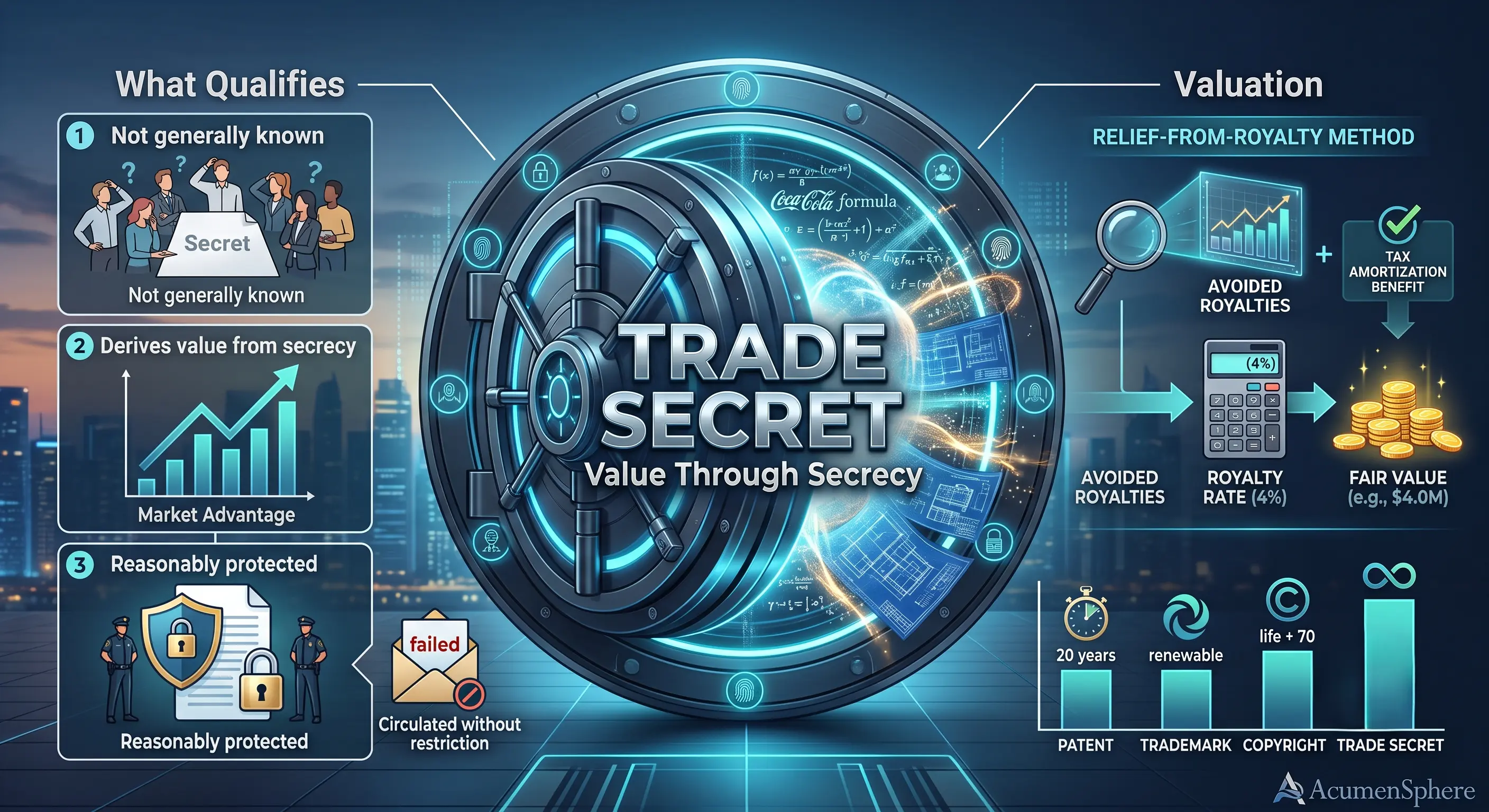
A trade secret is business information that has commercial value because it is not generally known, and which its owner takes reasonable steps to keep confidential. No registration, no filing fee, no expiry date.
The legal definition takes a paragraph. The harder question — the one that arises in an acquisition, a licensing negotiation or a dispute — is what the information is actually worth. This article covers both, with the valuation worked through to a figure.
What Qualifies as a Trade Secret
Three conditions must hold together. Information that fails any one of them is not protected.
Test | What it means | Common failure |
|---|---|---|
Not generally known | The information is not available to others in the industry | Widely understood industry practice |
Derives value from secrecy | Competitors would gain an advantage from knowing it | Information with no competitive relevance |
Reasonably protected | The owner takes active steps to restrict access | Circulated without restriction internally |
The third test is where most claims fail. Information can be genuinely valuable and genuinely unknown, but if it circulated freely inside the business with no access controls, the owner has not treated it as a secret — and a court is unlikely to either.
This is also what separates trade secrets and confidential information as terms. All trade secrets are confidential; not everything marked confidential meets the value and protection tests that give a trade secret legal standing.
Types of Trade Secrets
Category | Examples | Typical holder |
|---|---|---|
Technical | Formulas, manufacturing processes, chemical compositions, source code | Manufacturing, pharmaceuticals, software |
Commercial | Customer lists, supplier terms, pricing models, margin structures | Distribution, retail, services |
Strategic | Expansion plans, acquisition targets, negotiation positions | All sectors |
Operational | Quality control methods, logistics routing, internal know-how | Manufacturing, logistics |
The best-known example remains the Coca-Cola formula, protected as a trade secret since 1886. A patent filed at that time would have expired in 1903.
Where Trade Secrets Sit in Intellectual Property
Patent | Trademark | Copyright | Trade secret | |
|---|---|---|---|---|
Registration | Required | Usual | Automatic | None |
Public disclosure | Full | Mark only | Work itself | None |
Term | ~20 years | Renewable indefinitely | Life + 70 years | Indefinite |
Protects against | All use | Confusing use | Copying | Improper acquisition only |
Reverse engineering | Still infringes | n/a | n/a | Permitted |
Cost to obtain | High | Moderate | Minimal | Minimal |
Trade secrets differ from the rest in one structural way: the protection is against how the information was obtained, not against the information being used. A competitor who reverse engineers a product or arrives at the same process independently has done nothing wrong. Patent protection has no such gap — but it is bought with disclosure, and it expires.
The same distinction shapes valuation. A patent's economic life is bounded by its term. A trade secret's is bounded by how long it can realistically stay secret, which is a commercial judgment rather than a legal one, and directly related to the way brand equity is assessed for indefinite-lived assets.
Patent or Trade Secret: How the Choice Is Actually Made
Favours a patent | Favours a trade secret |
|---|---|
The innovation is visible in the product | The process is invisible to a purchaser |
Reverse engineering is straightforward | Reverse engineering is impractical |
The commercial life is shorter than the patent term | The advantage could last decades |
Licensing revenue is the objective | Exclusive internal use is the objective |
Investors expect a registered portfolio | Disclosure would hand competitors the method |
A manufacturing process that leaves no trace in the finished product is usually better held as a secret. A mechanical device that can be bought and dismantled generally is not.
Where Trade Secrets Appear on a Balance Sheet
Almost nowhere — until a transaction forces the question.
Internally developed trade secrets are not capitalized. The research and development that created them was expensed as incurred, so a company can hold information worth millions and carry nothing for it. Book value and economic value separate completely.
That changes on acquisition. Under ASC 805, a buyer must identify and measure at fair value the intangible assets acquired in a business combination, separately from goodwill. Trade secrets and proprietary know-how are explicitly among the categories to be identified, which means the valuation happens whether or not the parties discussed it during negotiation. The exercise is part of any purchase price allocation.
Trade secret value is also quantified in two other settings: licensing and transfer pricing, where a royalty must be set; and misappropriation disputes, where damages must be measured.
Valuing a Trade Secret
The standard technique is the relief-from-royalty method. It asks a single question: if the business did not own this information, what would it have to pay to license it? Those avoided payments are the economic benefit of ownership, and their present value is the value of the asset.
Consider a proprietary manufacturing process supporting the following revenue, with a 4% royalty rate drawn from comparable licensing agreements, a 25% tax rate and a 14% discount rate.
Year | Revenue | Royalty at 4% | After tax | Discount factor | Present value |
|---|---|---|---|---|---|
1 | $30.0M | $1.20M | $0.90M | 0.8772 | $0.79M |
2 | $33.0M | $1.32M | $0.99M | 0.7695 | $0.76M |
3 | $36.0M | $1.44M | $1.08M | 0.6750 | $0.73M |
4 | $38.5M | $1.54M | $1.16M | 0.5921 | $0.68M |
5 | $40.0M | $1.60M | $1.20M | 0.5194 | $0.62M |
Total | $3.59M |
The discount rate sits above the company's weighted average cost of capital because a single intangible carries more risk than the business as a whole. Selecting that rate is a matter of judgment, and it is the input reviewers question most often.
The Adjustment Most Models Omit
A buyer acquiring this asset can amortize it for tax purposes, and those deductions have value. Because a market participant would price that benefit into what they pay, fair value includes it.
Step | Calculation | Result |
|---|---|---|
Present value of avoided royalties | From the table above | $3.59M |
Tax amortization benefit multiple | 15-year amortization, 14% rate, 25% tax | 1.114 |
Fair value of the trade secret | $3.59M × 1.114 | $4.0M |
The tax amortization benefit adds $0.41 million — 11% of the answer. Omitting it understates fair value, and its absence is one of the first things an auditor looks for in an intangible valuation.
What Moves the Number
The royalty rate carries the most weight:
Royalty rate applied | Fair value |
|---|---|
3% | $3.0M |
4% | $4.0M |
5% | $5.0M |
A one percentage point movement changes the valuation by roughly 25%. Which is why the rate is supported with comparable licensing agreements rather than assumed — and why a valuation that states a royalty rate without citing its source is difficult to defend.
What Protection Preserves the Value
Protection is a legal matter for counsel. What matters in a valuation context is narrower: the protection measures in place are evidence, and their absence reduces both the legal claim and the economic life the valuation can support.
Reviewers commonly look for confidentiality agreements with employees and counterparties, access restrictions limiting the information to those who need it, physical and IT controls, exit procedures for departing staff, and documented records of what is treated as secret and who may see it.
A business asserting a valuable trade secret with none of these in place faces a difficult question in diligence — not about whether the information is valuable, but about how long it can be expected to remain protected. That directly shortens the forecast period, and a shorter period produces a smaller number.
What Reviewers Examine
A trade secret valuation submitted for audit, tax or transaction purposes is tested at the assumption level:
Whether the information genuinely meets the three qualifying tests
What supports the royalty rate, and whether the comparable agreements are truly comparable
How the remaining economic life was determined, and whether it is consistent with the protection measures actually in place
Why the discount rate exceeds the company's cost of capital, and by how much
Whether the tax amortization benefit has been applied
Whether the revenue base reflects only the products the trade secret actually supports
The last point is a frequent finding. Applying a royalty rate to total company revenue, when the trade secret supports one product line, overstates the asset — sometimes by a multiple.
Get Your Intangibles Valued Properly
Trade secrets are among the most valuable assets a business holds and among the least visible in its accounts. They surface in acquisitions, licensing negotiations and disputes — usually at short notice, and usually when a defensible figure is already required.
AcumenSphere values intangible assets for financial reporting, transactions and litigation support, with each input documented: royalty rate evidence, economic life, discount rate derivation and the tax amortization effect.
If you are acquiring a business, licensing proprietary technology, or quantifying a loss, contact our team to discuss what your situation requires.